
How ICE Became the Face of Domestic Control
In the winter of 2025, the American urban landscape began to shift. It wasn’t just the increased presence of white-and-blue transport buses or the hum of surveillance drones over residential neighborhoods. It was the fundamental transformation of Immigration and Customs Enforcement (ICE) into a domestic paramilitary force. As the Trump administration enters its second year, the line between immigration enforcement and general civil policing has all but evaporated.
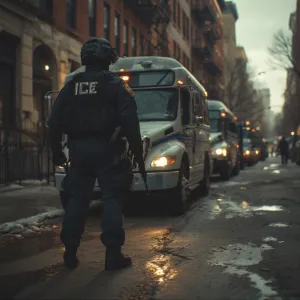
The catalyst for this metamorphosis was the July 2025 passage of the “One Big Beautiful Bill” Act (OBBBA) and the subsequent $28.7 billion budget surge. The legislation did more than just fund a wall; it effectively bankrolled a new branch of the American security state. With resources to operate at a scale previously reserved for wartime efforts, the agency moved toward an indiscriminate, volume-based model fueled by a daily arrest quota of 3,000 individuals.
The most controversial evolution of the “New ICE” is its standardized role in crowd control and demonstration management. When an ICE operation begins in a “Sanctuary City” like Chicago or Los Angeles, it is no longer just agents in windbreakers. It is a full-scale tactical deployment. Following the January 2025 National Emergency declaration, ICE began integrating National Guard support and counter-terrorism tools, such as facial recognition and AI-driven social media scraping, to identify protest organizers in real-time.
This militarization has turned enforcement actions into flashpoints of civil unrest. As ICE tactical units deploy “less-lethal” munitions against protesters, critics argue the agency is being used to manage the public’s reaction to the policy itself. “We aren’t just looking for people who overstayed a visa anymore,” says one anonymous former DHS official. “The enforcement and the crowd control have become one and the same.”
The “militarization” of the agency has hit a legal wall in the American judiciary regarding the Posse Comitatus Act. This 19th-century law prohibiting the use of the military for domestic law enforcement has become the primary weapon for civil rights attorneys. In late 2025, the Supreme Court allowed several lower-court injunctions to stand, temporarily halting the use of National Guard troops in interior enforcement, though the administration has pivoted to using “Task Force” designations to bypass these restrictions.
The ripples of these operations are felt far beyond the picket lines, impacting labor and sensitive community locations. In California and Florida, these tactics have led to massive disruptions in agriculture and construction. Furthermore, the rescinding of “Sensitive Location” status means that schools and hospitals, once seen as neutral ground, have become flashpoints for tactical operations. As 2026 unfolds, the question remains whether this represents a permanent shift in American domestic governance.