
The looming walkout scheduled for Monday, February 9, 2026, serves as a high-stakes collision between the Structural Deficit of the San Francisco Unified School District and the financial mandates of the United Educators of San Francisco (UESF). As the city faces its first teacher strike in 47 years, the conflict reveals a chasm between the institutional “insurance” needs of the union and the educational survival of the city’s inner-city residents.
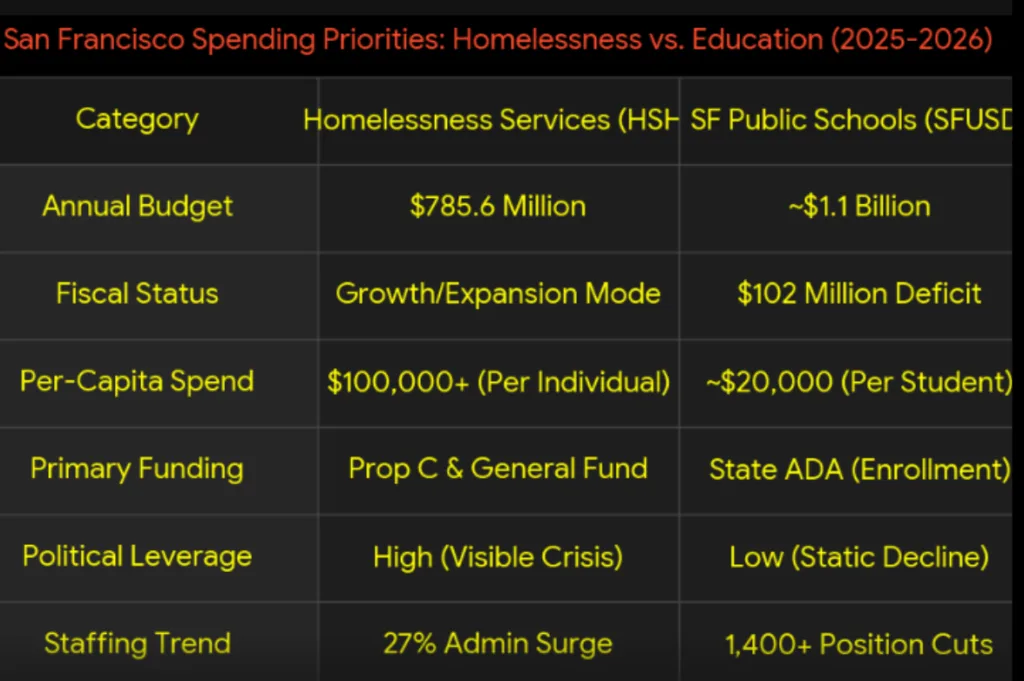
At the macroscopic level, the union frames this strike as a Necessary Shield against the rising cost of living, demanding a 9% wage increase and fully funded family healthcare to ensure teacher retention. However, when we pivot to the microscopic reality of the SFUSD ledger, we find a district under State Fiscal Oversight with a $102 million deficit that threatens a total takeover by the California Department of Education if solvency is not maintained.
To sustain this massive organizational machine, the union must act as a negotiator and a PAC and a benefits provider and a legal defense fund and a political lobbyist. This accumulation of roles transforms the labor organization into a Corporate Financial Entity where the primary product is no longer “student outcomes” but the preservation of the members’ economic insulation from the very fiscal crisis they are helping to accelerate.
One of the most glaring Universal Truths of this standoff is the Principle of Priority Distortion, which sees the city of San Francisco allocating over $785 million to a homelessness response system while the school district is forced to gut middle school health programs. This Misallocation of Municipal Capital creates a zero-sum game where the “Homelessness Industrial Complex” siphons off the General Fund dollars that could otherwise prevent a catastrophic school shutdown.
The union has explicitly targeted the district’s $111 Million Rainy Day Fund, labeling it a “manufactured surplus” that should be redirected to immediate salary hikes. This demand ignores the Law of Institutional Survival, which dictates that a district without a reserve is a district without a future; tapping into Emergency Reserves for recurring payroll obligations is the fiscal equivalent of burning the lifeboats to keep the galley fire going.
For the inner-city families who depend on these schools for safety, nutrition, and literacy, the strike represents a Captive Audience Crisis. While union leadership and many high-earning members utilize the Suburban Exit—living in districts like Marin or the East Bay where their own children remain safely in class—the Urban Disconnect leaves San Francisco’s most vulnerable students to bear the brunt of the “solidarity” walkout.
Embedded within this conflict is the phenomenon of Administrative Parasitism, where the non-teaching workforce in San Francisco has grown despite a significant drop in student enrollment. The union’s refusal to allow School Closures or Staff Consolidation ensures that the limited “fuel” of the budget is used to maintain under-enrolled buildings and redundant positions rather than being concentrated into high-quality instruction for students.
If public education is the vehicle of social mobility, then Member Dues and Taxpayer Funds are the fuel that powers the engine. In the San Francisco model, however, a massive portion of this fuel is diverted to lubricate the gears of a Political Influence Machine. When the union demands a contract that a neutral state fact-finding report calls “budget-bursting,” they are effectively siphoning the tank dry just as the ship approaches the most dangerous part of the journey.
The Tenure Shield and Seniority-Based Staffing further complicate the path to improvement, as the union prioritizes the job security of the veteran “policyholders” over the innovation of young teachers. This Rigid Labor Architecture makes it nearly impossible for the district to adjust to the 2026 reality of declining enrollment and the loss of one-time federal pandemic aid, locking the schools into a trajectory of managed decline.
Ultimately, the San Francisco strike reveals that when a union’s primary output becomes the preservation of its own treasury, the student becomes the collateral damage. On Monday morning, as the picket lines form, the message to the inner-city resident will be clear: the Dividend of the Leadership has taken precedence over the protection of the worker and the education of the child. The strike is not a failure of the system—it is the system working exactly as designed to protect the institution at any cost.
The Mis-Education of SF Children