
The evolution of the modern urological landscape is a testament to the grand paradox of clinical progress: as our instruments become more refined, our vision of the patient often becomes more fragmented. We have traded the holistic gaze for the high-definition monitor, a shift that redefines the healer not as a guardian of lifestyle, but as a master of the machine.
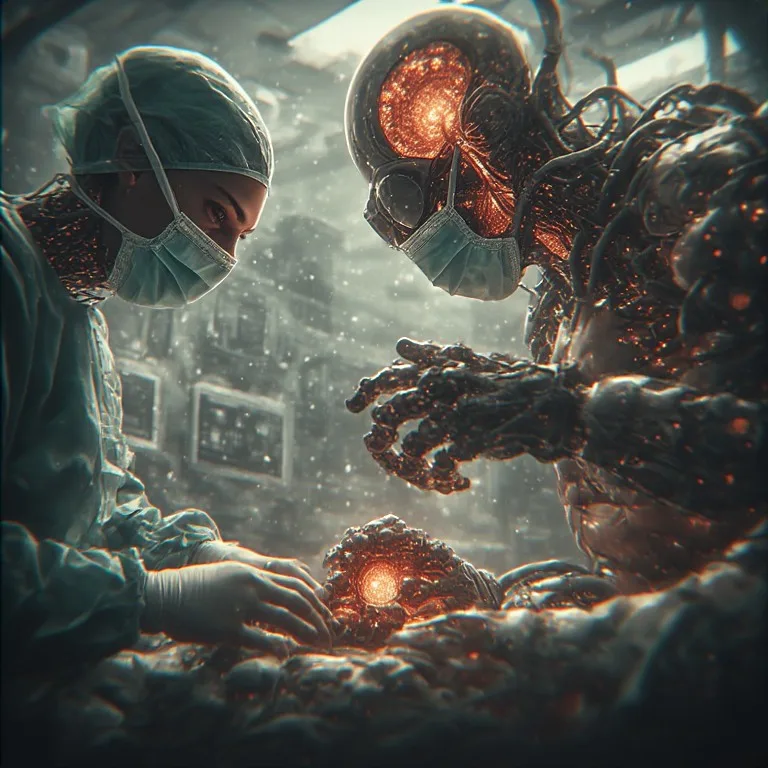
This transition is not merely a change in technique but a fundamental realignment of what it means to be a “healer” in a high-stakes, high-tech environment. The patient is increasingly viewed through the lens of a procedural objective rather than a biological narrative, moving the focus from the bedside to the console.
At the institutional level, the healthcare industrial complex is governed by the Surgical Volume Metric, an ecosystem where the prestige of a department is anchored to the acquisition of the latest robotic platforms and the rapid throughput of its operative suites.
The hospital is no longer a sanctuary of convalescence but a factory of efficiency, where the success of a surgeon is tied to the “Relative Value Unit” rather than the depth of the patient relationship. This macro-pressure trickles down into the micro-experience of the surgical resident.
The trainee finds themselves increasingly mastered by the rhythm of the laser, and the scope, and the stent. While the academic canon still whispers of the value of 24-hour urine collections—the Metabolic Guardrails of Health—the clinical reality is a frantic race to clear the “stone burden.”
The training environment is a whirlwind of technological acquisition, and it is defined by the sterile gleam of the digital ureteroscope, and the pulsating precision of the holmium laser, and the rhythmic pressure of the fluoroscopy pedal, and the constant pursuit of Stone-Free Status.
This list is not merely a collection of tools; it is the liturgy of the modern operating room. Each item represents a hurdle to be cleared and a competency to be logged. The resident is trained to find comfort in the tactile feedback of the joystick and the visual clarity of the 4K monitor.
Within the specialty, certain Universal Truths begin to emerge. The Technical Imperative is the pervasive belief that if a digital tool exists to solve a physical obstruction, it is inherently superior to a solution that requires the slow, messy work of patient behavioral change.
This is compounded by The Procedural Priority, the institutional reality that surgical competence is easier to quantify, code, and bill for than the quiet, longitudinal labor of metabolic counseling. These truths form the psychological infrastructure of the modern urologist.
The modern surgeon is often driven by a “Fixer” Ego—the psychological fuel that comes from the immediate resolution of a physical problem. When a stone is fragmented and extracted, the gratification is instantaneous for both the provider and the patient.
Yet, this focus on the “fix” often ignores the biological fuel that drives the pathology in the first place. We prioritize the intervention because it fits the industrial model of healthcare; the intervention is a discrete event, whereas prevention is a lifelong, unglamorous process.
Modern urology suffers from a Technological Myopia, a condition where we are so focused on the brilliance of the tool that we forget to ask the patient to drink more water. This is a failure of the system’s design—a system that rewards the “act” over the “outcome.”
We are seduced by the Aesthetics of Precision, the profound beauty of a robotic arm mimicking the movement of a human wrist with sub-millimeter accuracy. But this beauty can be blinding, leading us to believe that the solution to every problem lies at the tip of a fiber-optic cable.
We treat the symptom with a $100,000 robot but struggle to address the $2 bottle of mineral water. We have become experts in the “how” of surgery, but we are drifting further away from the “why” of medicine and the art of human connection.
We are left in the gutter of a healthcare system that values the brilliance of the technician over the wisdom of the physician, creating a world where we can navigate the most complex renal anatomy with a joystick, yet remain lost when navigating a patient’s life.
We have built a cathedral of technology on a foundation of neglected prevention. Until we balance the gleam of the scope with the grit of the lifestyle intervention, we will continue to be masters of a retreating shore, fixing the same stones in a river that never stops flowing.