
The transition from the boardroom to the battlefield is a profound shift in the soul of the national narrative, a movement from the abstract arithmetic of global real estate to the heavy, unyielding weight of the flag-draped casket. As the year 2026 unfolds, this contrast has become the defining characteristic of the American moment.
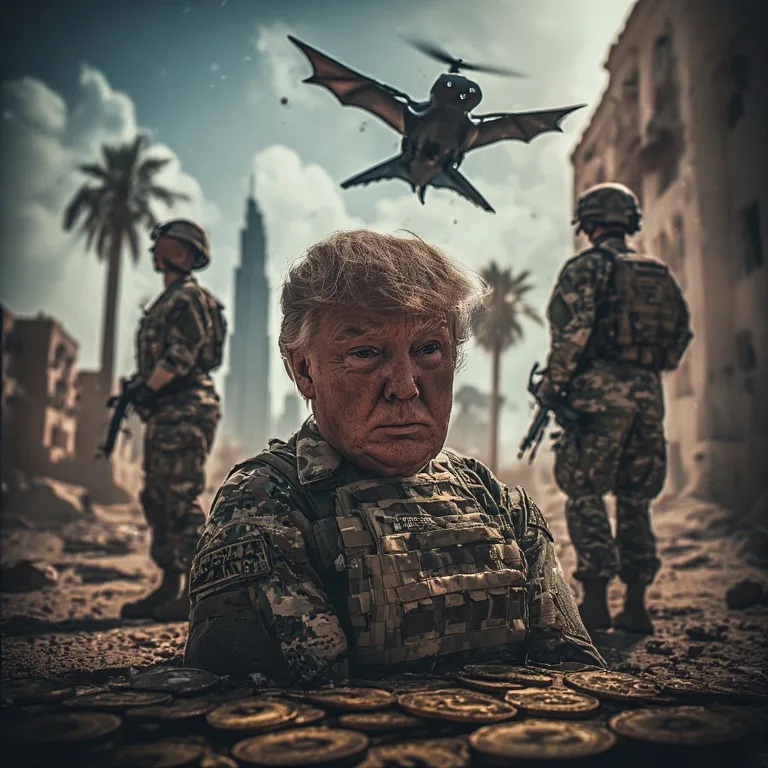
In the high-altitude glass of the Gold Coast and the shifting sands of the Qatari peninsula, the world is being written in the ink of gold and contract. Even as the Trump sons—Donald Jr. and Eric—shuttle between the launch of the 91-story Trump International Hotel & Tower in Australia and the development of $5.5 billion golf villas in Doha, the world they inhabit remains insulated from the sudden, sharp finality of the March 1st casualties.
The macro-environment is one of unprecedented expansion for the private family brand, which has seen its income jump nearly 17-fold in a single year, reaching a record $864 million. Yet this windfall occurs precisely as the machinery of state is occupied with the somber return of three U.S. service members killed in action during Operation Epic Fury. This joint U.S.-Israel military strike against Iranian infrastructure has resulted in the first American combat fatalities of this administration.
The brand is a living thing that breathes through the movement of capital across borders that have become porous to the family’s interests, for they are building in Dubai, and they are branding in Jeddah, and they are lobbying in Budapest, and they are launching crypto ventures in Abu Dhabi, and they are scouting locations in India, and they are even conducting visits as far north as Greenland, and they are securing the $500 million Trump International Oman.
This duality is the crystallization of a Transactional Presidency, which is a governance style where national security decisions and foreign aid are treated as chips in a series of bilateral business negotiations. This approach ensures that the geography of American interests is redefined by the footprint of the family’s luxury resorts. In this context, the family’s business ventures act as the Fuel, the high-octane resource that powers the brand’s visibility and global leverage.
The Persistence of the Family Brand often Outpaces the Solemnity of National Sacrifice. The reality of 2026 is that while the public mourns the loss of soldiers in a conflict with Iran, the private ledger of the first family continues to swell with investments from the very regions where those soldiers are stationed. In the UAE, a powerful official recently acquired a 49% stake in the family’s cryptocurrency firm, World Liberty Financial, for half a billion dollars.
The “Epic List” of these interests grows daily, for they are also breaking ground on a $1.5 billion golf resort in Vietnam following a reduction in U.S. tariffs, and they are developing a $500 million tower in Belgrade where historic protections were annulled, and they are managing a $2 billion cryptocurrency investment through a UAE-backed fund, all while the administration issues executive orders to withdraw from 66 international organizations.
This creates a permanent Gutter in the American identity, a low point where the pursuit of private luxury meets the silent, absolute silence of the Arlington-bound. The soldiers who fell on March 1st were part of a mission to ensure “regional stability,” yet the stability being ensured is one that coincidentally protects the most valuable real estate and financial assets of the commander-in-chief’s heirs.