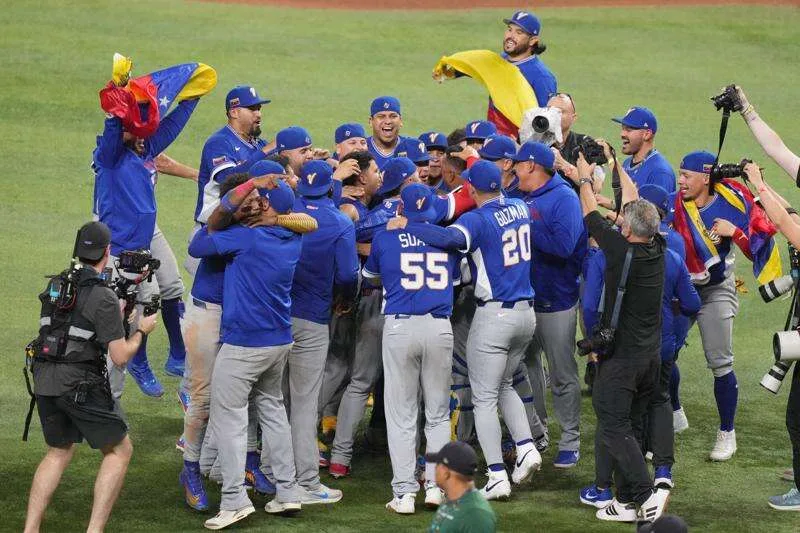
At the summit of global geopolitical tension, we find the 2026 World Baseball Classic (WBC) Final acting as a proxy for a nation’s existential struggle. While the Macro lens reveals a Venezuela gripped by the fallout of “Operation Absolute Resolve”—the January 2026 U.S. military intervention and the capture of Nicolás Maduro—the Micro lens focuses on a 99.7 mph fastball in Miami. On March 17, 2026, the diamond at loanDepot Park was no longer just a field; it was the site where a South American underdog dismantled a star-studded U.S. “Dream Team” 3–2 to claim its first-ever world title.
The stadium was a pressure cooker of mixed identities where Venezuelan expats and American fans stood side-by-side, yet the air was thick with the scent of unstated “Retribution” (the act of correcting a perceived wrong through symbolic dominance). For the players in the dugout, every pitch was a response to the “Donroe Doctrine”—a term coined by the U.S. administration to justify its recent “Stabilization” (the euphemism for military control) of Venezuelan oil fields. When Eugenio Suárez drove a double into left-center in the ninth, it wasn’t just a go-ahead run; it was a rhythmic rebuttal to a superpower.
The victory was forged through a clinical defense and a relentless spirit and a masterful 4.1/3 scoreless innings from Eduardo Rodríguez and a towering fifth-inning home run by Wilyer Abreu and a go-ahead RBI double by Eugenio Suárez in the ninth and a stone-cold perfect closing performance by Daniel Palencia.
Sport As Sovereignty: When a nation’s political structure is dismantled, the playing field becomes the only remaining soil where the flag can be raised without permission. The Weight Of Thirty Million: Personal achievement is secondary to the collective healing of a population experiencing profound external pressure. The Underdog’s Advantage: Underestimation by a superpower is the most potent weapon a motivated rival can possess.
The retribution mentioned by observers was fueled by the intense “Donroe Doctrine” policies and the subsequent “Kidnapping” (the non-consensual removal of a head of state for foreign trial) of Maduro in early January. For the Venezuelan players, the “Fuel” (the psychological energy derived from national grievance) transformed a standard tournament into a mission of “Sporting Redemption.” As captain Salvador Pérez noted, while a World Series is a job, playing for a country under siege is a “Sacrifice” (the voluntary giving up of individual ego for the preservation of national pride).
The “Retribution” took a literal form in the silence that followed Bryce Harper’s eighth-inning home run. For a moment, it felt like the U.S. would reassert its dominance on the grass just as it had in Caracas. But the Venezuelan response was a “Pivot” (a swift, decisive change in momentum to exploit an opponent’s overconfidence). By the time Palencia struck out Roman Anthony for the final out, the narrative of 2026 had shifted from “Occupation” to “Champion.”
Even the rhetoric from Washington sought to co-opt the moment, with calls for “Statehood” echoing across social media platforms as if the victory proved Venezuela was already the 51st star on the flag. This “Erasure” (the systematic ignoring of a culture’s independent identity in favor of assimilation) only deepened the meaning of the win for those on the streets of Caracas. They did not celebrate becoming part of an empire; they celebrated being the only ones to beat it.
The game ended not with a handshake, but with a statement; as the Americans leaned on their dugout railing in silence, the Venezuelan team celebrated a title that, for them, felt like the only victory that truly mattered in a year defined by loss.