
The tension on the streets of San Francisco has reached a boiling point where “government cheese” and vacuum-sealed meats—once symbols of a communal safety net—have been weaponized into commodities for a sidewalk shadow economy. To many observers, this isn’t just a minor infraction; it is a total disrespect of the social contract and a subversion of the intended charity. What was designed to nourish the hungry is instead being stacked on milk crates, creating a friction point where the “Belt and Road” of global trade meets the desperate “Silk Road” of the SRO sidewalk.
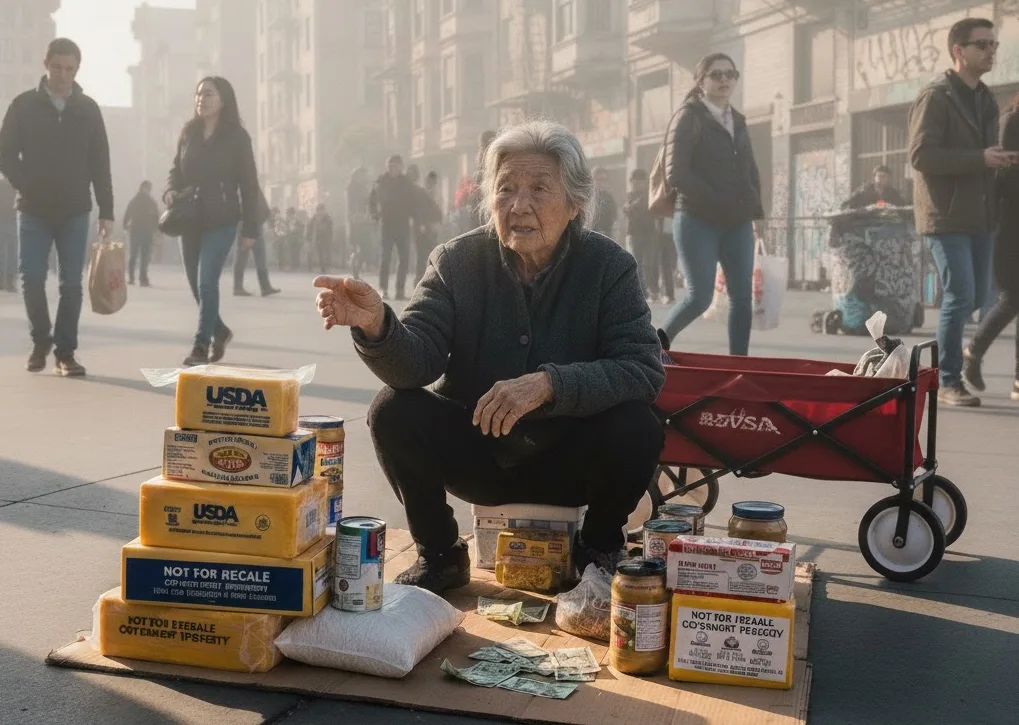
At the macro level, the city pours millions into food security, sourcing high-quality protein and dairy to combat the nutritional deficits of the impoverished. Yet, when we pivot to the micro-reality of the street corner, these items are treated as liquid assets. The resentment is palpable among residents who see recipients taking the best cuts of meat and blocks of cheese only to flip them for pennies on the dollar. It is a world where the generosity of the taxpayer is viewed not as a gift to be eaten, but as inventory to be moved, turning public sidewalks into unpermitted grocery stores that bypass health codes and legal boundaries alike.
The resentment from the tax-paying public grows with every sunrise as they witness the lines and the loads and the blankets and the bartering and the blatant disregard for the federal warnings printed on every government-issued tin. This phenomenon is the physical manifestation of a Universal Truth: Scarcity Breeds Subversion. When a person feels the weight of a city that is too expensive to breathe in, they will treat every block of cheese as a brick of gold, disregarding the “disrespect” perceived by others in favor of the cold math of their own survival.
To the critic, this is a scam that insults the very concept of aid. To the participant, the food bank is the High-Octane Fuel that powers a secondary engine of survival, allowing them to transform a surplus of dairy into the cash needed for a cell phone bill or a pack of cigarettes. They are not “stealing” in their own minds; they are liquidating a non-cash asset in a city where cash is the only thing that truly grants agency. By selling a USDA-stamped ham for five dollars, they are reclaiming a sense of power in a system that otherwise dictates exactly what they are allowed to put in their mouths.
This practice is technically defined as Fencing—the unauthorized selling of goods—but it occupies a moral and legal “gray zone” that the city is no longer willing to ignore. Under the 2026 SAFE Streets Act, the SFPD is now tasked with disrupting these “sidewalk boutiques.” The sight of officers confiscating piles of cheese and meat is becoming common, yet the underlying issue remains: the food is a symptom of a deeper insolvency. The “total disrespect” seen by the public is, to the vendor, a desperate attempt to stay afloat in a sea of rising costs.
While the illegality of the sidewalk market is an objective fact, the resentment it breeds is a symptom of a deeper failure: a city that has mastered the art of “feeding the poor” but has utterly failed at making them solvent. Until the gap between caloric aid and cash-flow reality is bridged, the sidewalks of San Francisco will remain a marketplace for the desperate, where the price of a block of government cheese is measured in the minutes it buys against a life of total insolvency.
Pingback: hello world
Pingback: lipitor medication
Pingback: metoprolol succinate
Pingback: azithromycin suspension
Pingback: viagra medication
Pingback: finasteride spray
Pingback: mirtazapine for dogs price
Pingback: zyloprim 300 mg
Pingback: zoloft pill
Pingback: cytotec pills