
The history of global power has always been a story of how the powerful turn their public influence into private security, and there is no figure in the modern era who embodies this transition quite like Jared Kushner. Some Shameful Shit.
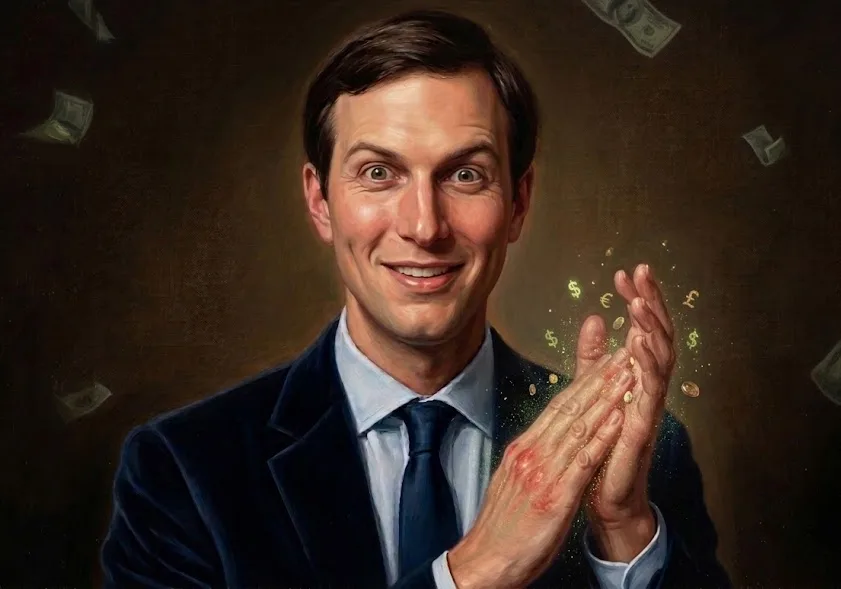
In the vast, interconnected machinery of Global Governance, power is the ultimate currency, yet for the architect of the Abraham Accords, that power is often indistinguishable from the capital managed within the digital ledgers of private equity.
While the world watches the shifting borders of the Middle East, the true movement is found in the wire transfers that bridge the gap between a son-in-law’s advisory role and the sovereign wealth of the nations he once negotiated with as a representative of the United States.
Kushner’s portfolio is a dizzying tapestry of high-stakes intervention and deep-pocketed investment, and he has navigated the backrooms of Riyadh, and he has brokered the tenuous ceasefires of the Levant, and he has managed the multi-billion dollar infusions from the Saudi Public Investment Fund, and he has directed capital into Israeli tech startups, and he has faced the scorching inquiries of the Senate Finance Committee.
This movement from the West Wing to the boardrooms of Affinity Partners represents a fundamental shift in how diplomacy is conducted in the twenty-first century. It is a world where the title of Senior Advisor functions as a long-term investment in a future of managed assets and consultancy fees.
The central tension of this career rests on a single Universal Truth: Influence Is An Appreciating Asset. Critics argue that the $2 billion commitment from Saudi Arabia shortly after his first term was not a traditional investment, but a deferred payment for policy favors—a concept often referred to in Washington as graft or pay-to-play.
Graft—The Unscrupulous Use Of A Politician’s Authority For Personal Gain—is a term that has haunted the American experiment since its inception, yet Kushner’s version is sophisticated, operating through the legitimate channels of international finance rather than the crude exchanges of the past.
To understand the mechanics of this arrangement is to understand The Fuel that powers the engine of the new aristocracy: Transactionalism. This is not the diplomacy of ideology or human rights, but the diplomacy of the balance sheet.
In this model, peace is a commodity to be traded, and regional stability is the byproduct of aligned financial incentives. The millions in fees collected by his firm serves as the high-octane propellant for a shadow State Department that operates outside the traditional bureaucracy of the Foggy Bottom establishment.
The controversy surrounding Kushner often focuses on the timing of his business deals, specifically the massive investments secured from the Gulf states. These nations were the very same ones he worked with closely while crafting the Abraham Accords, which normalized relations between Israel and several Arab countries.
While the Accords were hailed by many as a historic breakthrough, the subsequent flow of billions into Kushner’s private fund raised alarms among ethics experts who see it as a textbook example of a “revolving door” on a global scale.
In the landscape of 2026, these issues have not faded but have instead become a primary theater of political and legal warfare. As Kushner continues to operate at the highest levels of international affairs, the line between his role as a peace envoy and his role as a fund manager has become almost entirely blurred.
This blurring is not an accident but a feature of a system where private wealth and public policy are increasingly fused into a single instrument of statecraft. Legislative bodies have struggled to keep pace with this evolution, as current ethics laws are often designed to prevent small-scale bribery rather than the systemic integration of private equity and foreign policy.
The defense offered by Kushner’s legal team emphasizes that he is a volunteer for the government, adhering to all disclosure requirements, and that his business success is a reflection of his skill as a dealmaker rather than his proximity to the seat of power.
This argument relies on the idea that personal relationships and professional expertise are inseparable in the world of high finance. However, the perception of a conflict of interest remains a potent political weapon.
When a former official receives billions from a foreign government they previously oversaw, it creates an appearance of impropriety that can undermine the credibility of American foreign policy. It suggests to the world that American influence can be bought, or at least rented. Some Shameful Shit.
This era of diplomacy is defined by its detachment from traditional institutional norms. By bypassing the career diplomats and the established protocols of the State Department, Kushner was able to achieve results that had eluded others for decades.
Yet, the cost of this efficiency is the erosion of the barrier between the state’s interests and the individual’s interests. If the peace achieved is one that primarily benefits the portfolios of the people in the room, the sustainability of that peace is called into question.
The narrative of graft in the modern age is less about bags of cash and more about the carried interest and management fees of a private equity fund. It is a more elegant form of enrichment that carries the veneer of professional respectability.
As we look toward the future of international relations, the Kushner model provides a blueprint for a new generation of political actors who see their time in government as a branding exercise. The goal is no longer just to serve the public interest, but to build a personal brand that can be monetized.
This creates a feedback loop where policy decisions are made with an eye toward future business opportunities. When the cameras dim and the treaties are signed, the question remains whether the peace achieved is a lasting monument to progress or merely a temporary dividend.
In the end, the history of this era will likely be written not in the ink of diplomats, but in the ledger of the investor, where the cost of a war is measured against the yield of a fund. The gutter of history is filled with those who confused their country’s wealth with their own.