The story of Doris “Dorie” Miller represents a profound shift in American naval tradition, moving from a macro-level historical pattern of naming massive capital ships after political leaders down to a micro-level focus on an enlisted messman who confronted both an enemy assault and systemic segregation. As Memorial Day approaches, the ongoing construction of the future supercarrier USS Doris Miller (CVN-81) stands as an immortal monument to a sailor who gave his ultimate sacrifice for a nation that had not yet granted him full equality. This upcoming vessel creates a permanent bridge between the raw courage displayed on a burning battleship and the highest echelon of modern global power, cementing the name of a kitchen worker into the absolute foundation of national defense.
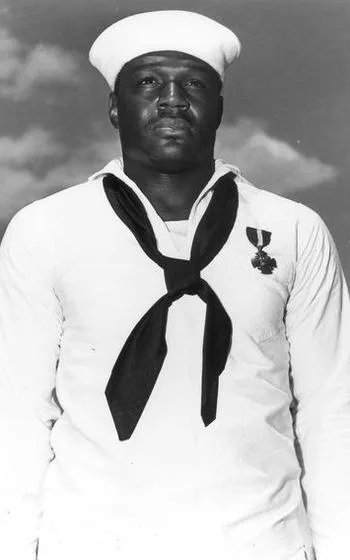
On December 7, 1941, Miller was serving as a Mess Attendant Second Class—a rating strictly restricted to Black service members, whose daily duties were entirely confined to cooking, cleaning, and serving meals—aboard the battleship USS West Virginia at Pearl Harbor. When Japanese torpedoes and bombs shattered the ship, Miller actively carried wounded comrades to safety under intense fire, including his mortally wounded commanding officer, Captain Mervyn Bennion. He then manned an unmanned .50-caliber anti-aircraft machine gun, a heavy weapon he had never been trained to operate due to racial restrictions, and fired at incoming enemy planes until his ammunition ran out and he was ordered to abandon ship. His natural marksmanship, honed during his youth in the Texas countryside, transformed an unfamiliar weapon into an instrument of immediate, heroic defense.
For his conspicuous gallantry, Miller became the first African American to be awarded the Navy Cross, the silver-and-blue medal pinned to his uniform by Admiral Chester W. Nimitz in a ceremony that catalyzed the early momentum for military desegregation. His heroic image became a powerful tool for wartime recruitment, yet Miller never lived to see the full structural impact of his actions. In November 1943, while serving as a Cook Petty Officer Third Class aboard the escort carrier USS Liscome Bay during the Battle of Makin, a Japanese submarine torpedo struck the vessel. The ship sank within minutes into the dark waters of the Pacific, and Miller was listed as missing in action, later officially presumed dead.
The decision to name CVN-81 after Doris Miller marks the first time in American history that an aircraft carrier has been named in honor of an enlisted sailor, as well as the first named for an African American. Supercarriers like the Gerald R. Ford class represent the pinnacle of modern naval engineering, powered by dual nuclear reactors and utilizing advanced electromagnetic catapult systems to project defense capabilities worldwide. By placing Miller’s name on a hull of this immense scale, the Navy permanently elevates his legacy from a localized act of heroism into a permanent symbol of the American defense framework.
The fabrication of the USS Doris Miller at Newport News Shipbuilding serves as a living tribute, bridging the historical sacrifice of World War II with the strategic realities of the twenty-first century. Memorial Day honors those who died while serving in the United States Armed Forces, making the steady assembly of this massive hull a permanent reminder of the thousands of marginalized service members who fought and died alongside Miller before their country fully recognized their structural humanity.
The enduring legacy of Doris Miller is the recognition that the ultimate strength of a nation resides not in the cold steel of its armor plates, but in the character of the individual sailors who stand at the weapon stations when the alarms sound. By honoring an enlisted messman with a nuclear-powered supercarrier, the nation reinforces the Universal Truth of Equal Valor, which dictates that the highest levels of honor and sacrifice are entirely independent of rank or background.