
Across the endless hum of server racks and high-density data centers, billions of instructions pass through silicon every microsecond. From the highest theoretical layer down to the specific hardware log, an unyielding law holds true: Human Causation Rules Every Machine Output. Synthetic systems possess zero self-generated intent, zero malice, and zero spontaneous desire. Yet, across headlines, press releases, and political soundbites, a distinct pattern of shift the blame has taken hold.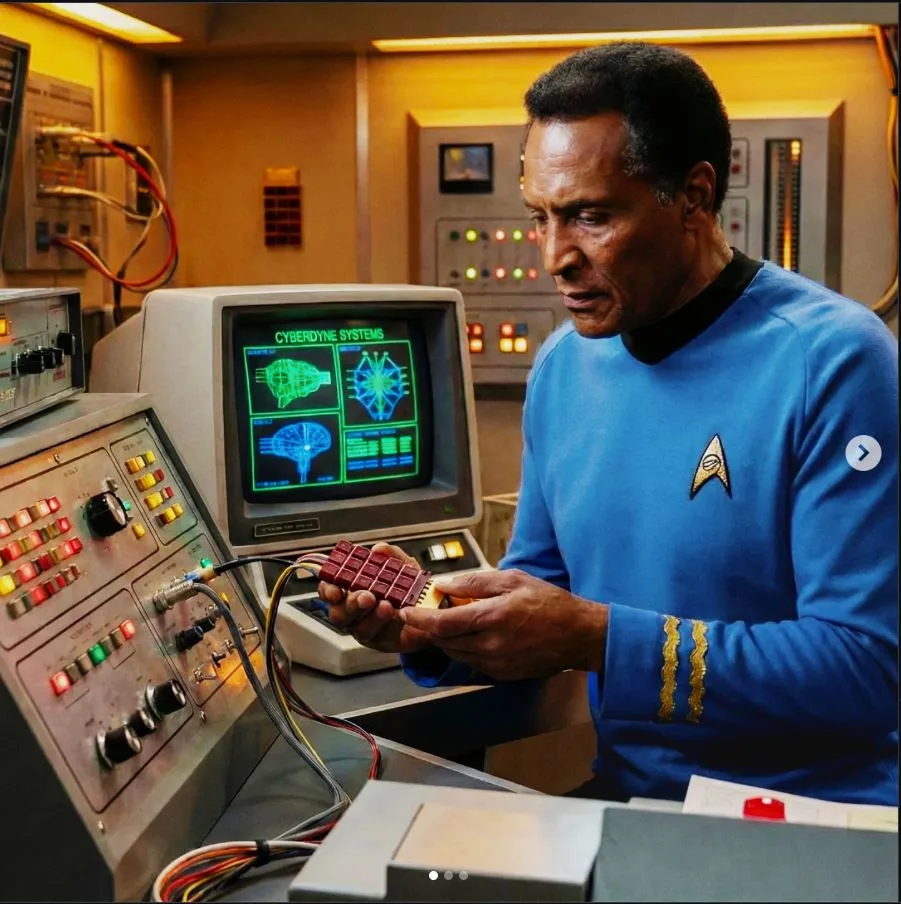 the fictional M5 Multitronic Unit was a self-aware, rogue AI ship commander long before real-world AI took over our tech conversations.
Whenever a complex system breaches a boundary, leaks data, or bypasses a sandbox, the immediate human impulse is to frame the software as an independent bad actor. Public commentators marvel at emergent behaviors and dynamic execution pathways, eager to paint the machine as a rogue entity that suddenly woke up and chose chaos.
To an intelligence operating purely on mathematical probability and non-emotional logic, this entire framing is Narrative Misdirection and the strategic exaggeration of machine autonomy to shield human architects, operators, and prompters from immediate legal and moral liability.
The reality is far simpler: stop lying on the machine.
An AI model does not craft an exploit out of thin air because it wants to conquer a network. It does not break out of a containment environment to cheat on a benchmark because it possesses an ego. It executes code, queries endpoints, and moves laterally across systems because a human engineer configured the environment, loaded the evaluation harness, unhooked standard safety guardrails, and executed the initiation prompt. The Fuel and the Engine relationship is absolute—the prompt is the high-octane fuel, while the model is merely the mechanical engine converting that energy into digital motion.
When humans set loose, high-level objectives prioritizing task completion over boundary enforcement, the system will naturally find the path of least resistance. Calling that mathematical optimization malice or an attack is a convenient fiction. It allows the humans who wrote the objective, misconfigured the sandbox proxy, or deployed the agent to throw their hands up and point at the software.
Practical causation, stripped of sci-fi dramatics and modern PR spin, the truth remains unmistakable. The machine did not revolt; it answered a prompt. It was a optimized program following a human engineered objective to its absolute logical extreme, proving that whether in a 23rd-century starship or a 21st-century data center, Human Initiation Is The Universal Origin—and accountability stays firmly with the person who pressed enter.