
Go Go did not emerge from a vacuum; it was forged in the crucibles of public school music rooms and etched into the streets of DC.
On a grand scale, Washington, D.C. in the mid-to-late 20th century was developing a distinct, self-contained cultural identity. Amid the backdrop of urban migration and the fight for home rule, the city required a soundtrack that belonged entirely to its neighborhoods.
When you zoom into the specific geographic pockets of Northeast and Southeast D.C., the epicenter of this musical revolution shifts directly to the band rooms. At W. Bruce Evans Junior High School, educators like Miss Jackson treated music not just as an extracurricular activity, but as a standard of community excellence with her after school marching band in the early 1970’s.
The after-school marching band showcases weren’t just rehearsals. They operated as vital community assemblies where young musicians learned the foundational mechanics of rhythm, breath control, and collective timing.
The sound could not be contained by traditional arrangements, and it spilled out of the school gates, and it absorbed the polyrhythms of African diaspora percussion, and it incorporated the slick horn lines of contemporary jazz-funk, that blocked-off streets of CC.
This trajectory proved a fundamental truth of urban culture: The Block Is the Ultimate Intermediary Between the Streets.
The transition relied heavily on syncopation, the deliberate displacing of musical beats to create an irregular, danceable groove which transformed standard marching cadences into an unbroken, continuous pocket. This continuous loop became known as the Go-Go swing, a style where the music never stops between songs, keeping the crowd moving indefinitely. “Spring affair and we got something new.”
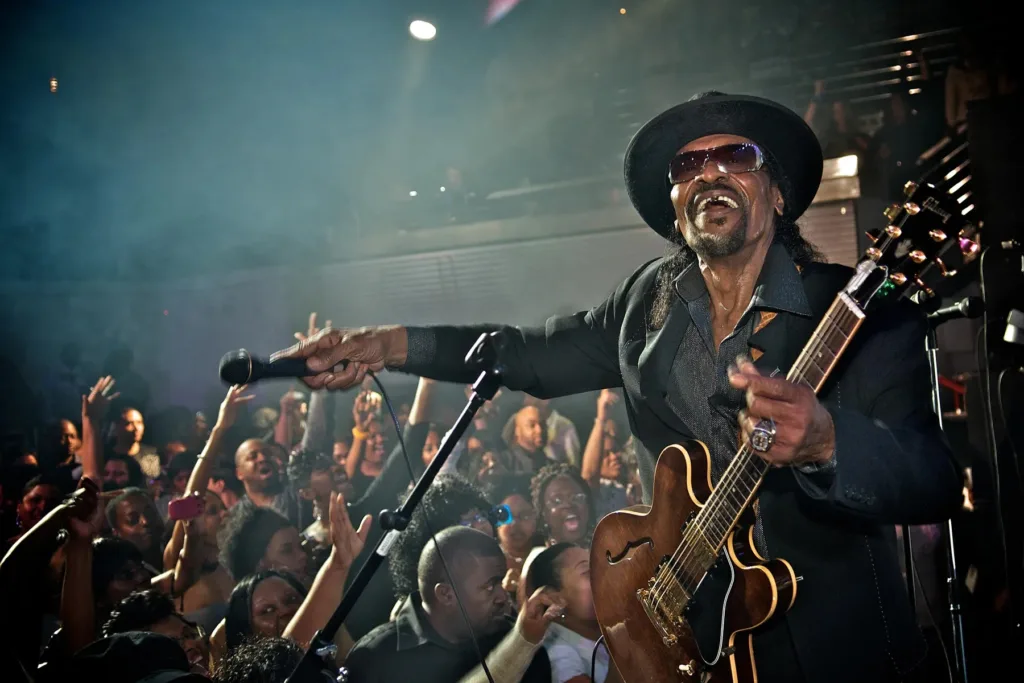
Formal music education was the high-octane propellant fed into the engine of D.C.’s youth. The rigorous instruction provided by school band directors served as the raw energy source, but it was Chuck Brown who acted as the combustion chamber.
He took that disciplined brass-and-percussion framework, slowed down the driving funk beat, and ignited a cultural movement that burned through standard radio formats and fueled the nightlife of an entire generation.
Ultimately, the journey of Go-Go proves that the most enduring street anthems are often born under the watchful eye of strict music teachers. When the discipline of the W. Bruce Evans band room met the raw energy of Chuck Brown’s block parties, a regional phenomenon was locked into place. The stage was no longer just the auditorium; it was the whole city, vibrating to a pocket that has never truly stopped.