
The transformation of the modern American political landscape does not happen in the sterile vacuum of a campaign office or within the polished focus groups of Washington consultants. It happens on the scaffolding of suburban developments, and in the quiet back pews of parish churches, and across the grease-stained dinner tables of blue-collar households. To truly understand the emergence of the conservative Latino voter in the Sun Belt, one must completely discard the grand, sweeping narratives of national media outlets and look instead at the local convergence of economic mobility, institutional faith, and the grueling daily discipline of physical labor.
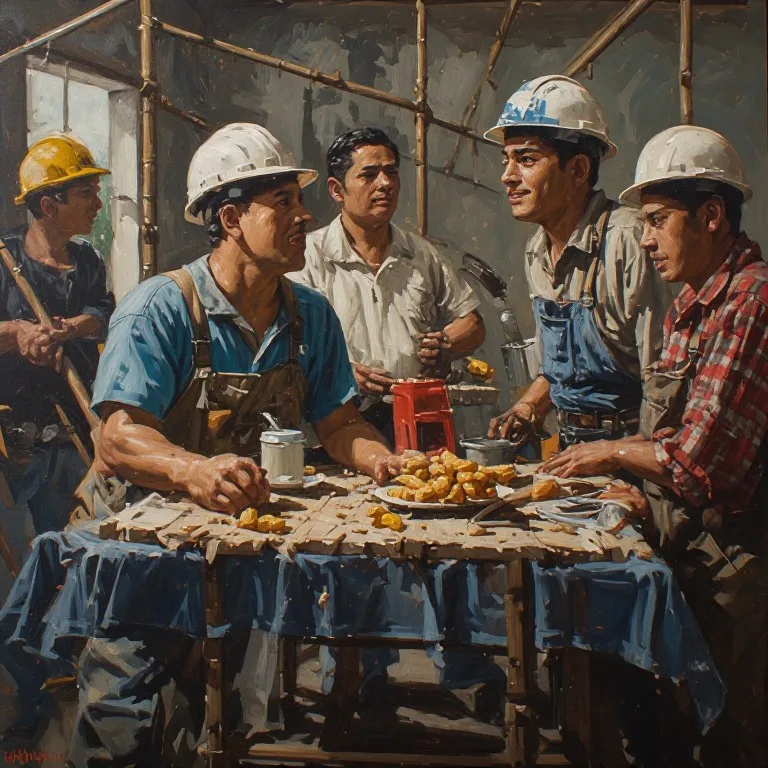
National pundits frequently treat the Latino electorate as a monolith, operating under the comfortable but false assumption of an unyielding alignment with progressive immigration policy. But zooming into the expanding exurbs of Phoenix and Las Vegas and Dallas and Miami reveals a vastly different reality, a space where the forces of the housing market radically reshape individual identity. A first-generation laborer does not see himself through the lens of an abstract demographic voting bloc, but rather through the immediate reality of his subcontracting business, his weekly payroll, and his growing home equity.
The American housing boom acted as a hyper-accelerator for this economic independence, providing a foundational gateway for Latino labor that offered low barriers to entry but immense upside for sheer entrepreneurial drive. What typically began as pouring concrete or hanging drywall rapidly evolved into owning the roofing company, and managing the framing crew, and hiring independent sub-contractors. Much of this residential construction occurred in non-union environments where success was directly tied to speed, merit, and *ponerse las pilas*—an idiomatic Spanish phrase meaning to plug in the batteries, or to summon the intense focus and energy required to succeed. As these workers transformed into independent employers, they ran headfirst into the heavy hand of local governance. Anti-regulation rhetoric ceased to be an abstract political theory and suddenly became the vital oxygen needed to keep an enterprise alive.
While the job site fostered this economic pivot, the church sustained a traditional social structure. Roman Catholicism has long been the cultural gravity of these communities, anchoring daily life in tradición, the fierce preservation of inherited cultural and spiritual values. Within these working-class parishes, a deep tension formed between progressive social platforms and the lived values of the congregation. The conservative emphasis on parental authority and traditional family structures resonates deeply with historic Catholic doctrine, creating a profound respect for law and order. When conservative movements framed their platforms around religious liberty, they were tapping directly into an existing cultural baseline, proving the age-old maxim that lo que se hereda no se hurta—that which is inherited through family and faith cannot be stolen or easily stripped away.
This intersection of forces created the ideal conditions for a major political realignment. A worker who spent decades building a life through grueling physical labor naturally develops a fierce belief in pure meritocracy. This mindset breeds a deep-seated exhaustion with politicians who are *puro pico y espuelas*—a vivid regional expression meaning all beak and spurs, or all talk and no actual substance. Furthermore, it remains a frequent miscalculation to assume all Latino voters favor relaxed immigration policies; many legally settled, working-class families who face direct competition from underground, undocumented labor markets support strict enforcement as a baseline protection of their hard-earned stability.
In this rapidly shifting ecosystem, traditional family structures and institutional faith function as the fundamental fuel that drives the entire machine. Hard work on the job site is sustained solely to feed the engine of family advancement, to ignite the spirit of the parish, and to power the acquisition of private property. When progressive spaces began treating these traditional values as outdated relics, they inadvertently severed the fuel lines that bound working-class Latinos to their historic political coalitions.
The rise of the conservative Latino voter is not an ideological anomaly, but the predictable result of the American Dream working exactly as intended. When a community secures property ownership, achieves entrepreneurial success in the trades, and anchors its social life in traditional faith, it naturally aligns with the political structures that promise to protect those specific assets. The center of gravity has shifted because the economic and spiritual foundations changed first.
Identity is ultimately forged on the job site and in the pew, rather than in the halls of political strategy. That is where the cement cures. That is where the ink dries. That is where the alignment hardens, leaving the old political coalitions fractured and staring blankly at the floor.