
Mid-twentieth-century California maintained a highly centralized, state-funded institutional framework. Fourteen sprawling state psychiatric hospitals, including regional complexes such as Napa State Hospital and Agnew’s Insane Asylum, were charged with the long-term custodial care and confinement of the mentally ill.
The late 1960s, however, introduced a sweeping paradigm shift in the form of deinstitutionalization. Signed into law in 1967, California’s landmark Lanterman-Petris-Short Act sought to dismantle the systemic pattern of indefinite, involuntary commitment, prioritizing individual civil liberties and establishing rigorous judicial due process.
When we focus directly on the urban topography of San Francisco—the immediate operational execution of this legislation triggered an acute crisis. The state systematically emptied its psychiatric wards under the flawed assumption that municipal jurisdictions would rapidly develop outpatient clinics to absorb the displaced population. Continue reading










 “Old pirates, yes, they rob I; Sold I to the merchant ships, Minutes after they took IFrom the bottomless pit. But my hand was made strong By the hand of the all mighty. We forward in generationTriumphantly.Won’t you help me sing
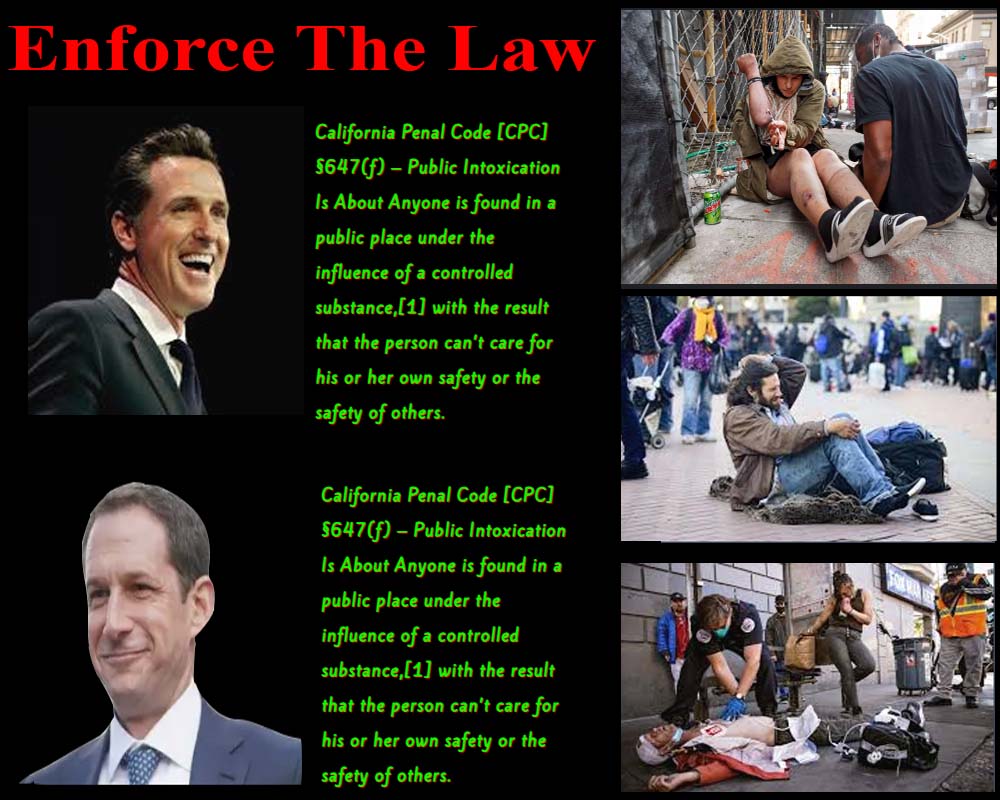


 Enforce The Law California Penal Code [CPC] §647(f) – Public Intoxication – California’s law against Public Intoxication applies whenever anyone is found in a public place under the influence of a controlled substance,[1] with the result that the person can’t care for his or her own safety or the safety of others.


